Inhale. Exhale. Inhale. Exhale.
This is my very first blog post ever! Exhale. I wonder where this writing experiment will take me. Inhale.
Ok. That was a good start. But no really, I want to begin this project in dedication to that which inspires, to life itself. Without the breath, without Carbon Dioxide and Oxygen together, there would be no life. That’s just what the intention of my new blog is, to explore the connection of the magic of life through the sadhana (practice) of Yoga and practice of cultivating the earth, this Garden.
“Truly, it is Life (prana) that shines forth in all things! Understanding this, one becomes a knower.” – Mundaka-Upanishad, The Thirteenth Principle Upanishads
In Yoga, we also call the breath, or life force energy, Prana. Prana literally means “to breath forth”, and if you get a dictionary defination you may find other words like vitality, vigor, energy, power, spirit. Prana touches every corner of the universe.
One of the eight limbs of Yoga is pranayama, which is the practice of expanding our breathing, and directing pranic energy to the body-mind. Ayama literally means “to stretch, extend; restrain, stop; expand, lengthen in either space or time….or control”. The sanskrit root of ayama is yama, and means “rein, curb, bridle; a driver, charioteer”. The practice of directing prana can be classified in subgroups of vayus, or winds. Vayus are subtler forms of prana that simultaneously circulate breath in specific movements through the body-mind, and represent the very currents of aliveness that animate our beings.
Did you know that plants also breath? Below is a very basic illustration of the relationship of the breath between living beings and plant life.
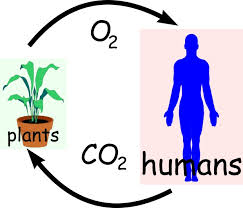
As you can see, we each depend on the exhale and inhale of the other in order to sustain our lives, and to participate in the awakened breath of life. There are more complicated diagrams describing intricate relationships between other elements of life and our synergy with each other, but for the sake of simplicity, lets just work with prana.
There are some simple pranayama techniques that you can begin with to deepen and feel these currents of aliveness. I will leave you with a very basic starting point at the end of this post, or you can contact me for further teachings on technique as pranayama is not something to be practiced lightly…its subtle powers can move ALOT of energy that is stuck in the body and its good to have a teacher to work with if you are just beginning. You can imagine as you begin your pranayama practice that you are exchanging breath with the plants too! This will begin to inform the practice of listening and observation with the plantworld and the garden as a whole. This is really step one not only in yoga, but also in working with plants. Listen and watch….track the breath. Begin to allow the breathing practice to unite your awareness to the body and to the world around you. After a while maybe you can start to sense the garden as alive too.
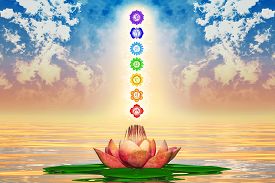
When I walk into a healthy garden, or any natural area, I can feel it breathing. When I prune the dead out of trees or trim the garden to allow more space for air and all the elements to be equally received by the plants, I can sense the vitality grow in the garden. In the pranayama practice and in the asana (postures) practice, the breath is like a pruning tool. It clears and vitalizes the energy centers (chakras) of the body, sending prana through nerve bundles called nadis (approximately 72,000 of them!). Nadi comes from a sanskrit root word nad which means channel, stream, or flow. The channels are very much the same as the veins of a leaf delivering food to the rest of the plant, the very same food that is obtained from the CO2 we exhale and the sunlight.
We cannot begin an integrated yoga practice without this understanding of prana, nor can we begin to tend a garden towards health without this basic understanding that the plants also breathe. Knowing that we share this breath brings us into closer relationship. With this intimacy, each breath in the garden becomes an offering. You can be in your special garden sanctuary or the middle of New York City tending your indoor plants, the relationship still exists. Cultivate your awareness to this ongoing exchange and see how your next steps in the garden become a little more alive. See if the garden appears different to you. Begin to see the spaces between the plants, between the leaves, between the trunks and stalks, as just a critical as the plant itself. Go even further and begin to see the relationship of each plant to another. Expanding your view to the whole garden, (eventually the whole planet!) we can imagine fully how the forests are breathing for us and how much their health is essential to our life on earth.
Tracking the breath in the garden is just like tracking the breath in the body in meditation, pranayama or asana. When you go to your seat or your mat, you are entering that same intimate relationship with the breath of life. You can turn a static pose into a dynamic pose just by committing to follow the breath through each energy center and nerve channel. It may take a lifetime or more to actually track 72,000 nadis, but you can see where this is going. By slowing down the breath and letting it “shine forth” through each cell, you have just given your body permission to access its full healing potential, its innate right of health. Your body can restore itself in this way, as it returns to a tranquil state.
From Patanjali’s Yoga Sutras, which explains the unfolding of the science of yoga, we find the following :
Sutra 1.34 prachchhardana vidharanabhyam va pranayama
It translates: The mind is also calmed by regulating the breath, particularly attending to exhalation and the natural stilling of breath that comes from such practice.
How we choose to practice yoga is entirely up to each one of us. As I have grown on this Yoga path, I have discovered that the more I listen to my body, the more I can discover where the breath needs to go. Therefore we need to practice in a way that we can stay attuned to what is happening within. If we practice with too much intensity, we can miss the subtle pathways that are desiring our deeper attention and therefore our deeper potential for health and healing. Its something to explore for yourself. Its also entirely possible to practice with intensity and be fully aware of the breath within. There are no limits in the science of yoga, just our personal truth and honesty of our own limitations which will serve us well to unveil. In asana and pranayama, it can be particularly helpful to focus on the transitions between the inhale and the exhale as a tool for listening to the body, with an awareness towards allowing this transition to be smooth and without abrubtness. Focusing on elongating the exhale will extend the breath and release tension, blocked energy, and toxic build-up in any form.
SO this is just a beginning and the beginning is about the basics, because the basics are where its at! I have sought to disprove this at many many points of my journey when my will and ego are fighting for dibs on my awareness, but I keep coming back to the same basic principles, with more and more reverence each time. No matter what you are doing at any point in your day, you can tune into your breath and discover how diversely the pathways of prana are moving through you. You may have to walk slower to do this, or drive slower, or eat slower, or think slower…..or……slower……and…..you can link with the garden in each breath….also. You can link with the inhale and the exhale of every plant and tree that you see or don’t see in your immediate 5 ft radius….try that for a start. In fact, go find a place to sit, and with each exhale, kindly offer it up to the garden. Then gratefully receive the next inhale from the garden. And continue….and listen….and then watch. Observe what looks different from this conscious exchange. You may begin to even SEE the places in the garden where energy is stuck. This will be good information to carry with you as you decide how you want to interact with your Garden today. You may see something you never saw before in nature. You may see flower, a bee, a drop of water, a worm, a stone….you may see a dance, a song, or a story.
Pranayama Practice. Equal inhale, equal exhale.
Find a comfortable seat, where your sitzbones are level to the ground, and the spine is lengthened. You can also lie down. Creating a straight spine is going to allow the prana to move through the energy centers more easily and deliver prana to the body-mind. Do not sit in a way that causes any strain on your body.
Place one hand on the belly-abdomen and one hand on the chest-lungs. Begin by feeling the relationship of the natural breath in these areas. Experience your hands rising and falling in a rhythmic tide. Notice if there are areas that are not receiving this tide of breath and bring awareness to those parts, especially beneath the palms.
Begin to inhale slowly from the base of the spine and count the inhale to the top of the lungs in a count of 5. Slow the breath down so that you can extend the breath in 5 counts from the pelvic floor, to the belly, to the heart, to the lungs and collar bones. With your awareness let the breath also spread wide, horizontally across the body. Once you have arrived at the top of the inhale in the upper most parts of the lungs, begin to count to five in the same slow exhale, revisiting those parts of the central column along the straight spine, until reaching the count of 5 at the pelvic floor again. Turn around, transitioning slowly and with ease, and begin the inhale again counting to 5, then the same exhale for five. Repeat these rounds of inhalation and exhalation for 5 rounds, then return to natural breathing.
You can increase the count as you increase your breathing capacity. Don’t push yourself. You can also increase the amount of rounds you do before returning to natural breathing. When your done with this simple pranayama, lie down and allow yourself to integrate the sensation of prana in the body, and track the qualities of aliveness through the tissues, organs, bones, brain and blood. Enjoy knowing that you are restoring your health and well being in the most simple way, as well as creating intimacy with the Breath of Life in all of nature.
 The Garden of Yoga
Leave a comment